
By MATTHEW K. ADAMS, MD, MBA
If you’re over 40 and have ever said, “Why do my glasses never seem strong enough?” or “Why is it so dark in here?” then welcome to the club. One of the most common reasons for these visual changes is cataracts. The good news is that cataracts are extremely common, very treatable, and one of the great success stories of modern medicine. Let’s clear the fog…literally.
What Exactly Are Cataracts?
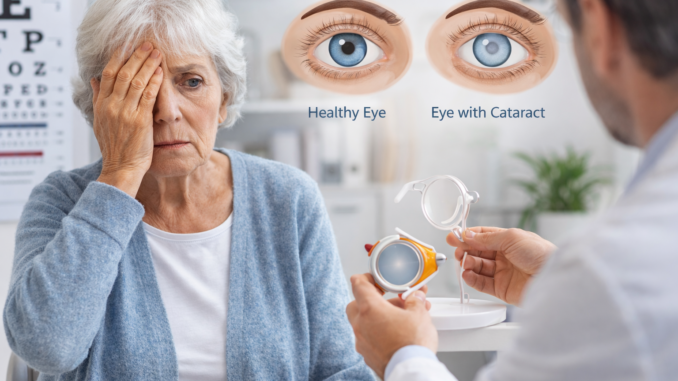
Inside each of your eyes is a natural lens, about the size of an M&M, whose job is to focus light so you can see clearly. When you’re younger, that lens is crystal clear, like fresh window glass. Over time, however, proteins inside the lens begin to clump together. As a result, the lens becomes cloudy. That cloudiness is called a cataract.
Cataracts are not a growth, a film on the eye, or something you “catch.” They are simply a normal part of aging. In fact, by age 50, more than half of adults have some visual impact of cataracts, even if they don’t realize it yet. By age 80, the number is closer to 100%.
What Do Cataracts Feel Like?
Cataracts don’t show up overnight. They sneak in slowly, which is why many people blame their glasses, or the lighting, or their phone’s font size.
Common symptoms include:
- Blurry or cloudy vision
- Increased glare from headlights or sunlight
- Trouble seeing at night
- Halos and “starburst” patterns around lights
- Colors appearing dull or yellowed
- Needing brighter light to read
- Frequent changes in glasses prescriptions
A classic complaint I hear is: “Doctor, I don’t feel comfortable driving at night anymore.”
Importantly, cataracts do not cause pain, redness, or sudden vision loss. If those occur, something else is going on, and you should be seen promptly.
What Causes Cataracts?
The biggest risk factor is time. Aging is the main culprit. But several other factors can speed things up:
- Sun exposure
- Smoking
- Diabetes
- Certain medications, especially steroids
- Eye injuries or prior eye surgery
The main takeaway is that cataracts are common, expected, and not your fault.
Can Cataracts Be Prevented?
In short…No. However, measures can be taken to slow them down. Wearing UV-protective sunglasses, eating a balanced diet, managing medical conditions like diabetes, and not smoking can all help.
But eventually, most of us will develop cataracts, just like wrinkles, gray hair, and a sudden interest in lawn quality.
How Are Cataracts Treated?
Important note here: there is no medication, vitamin, eye drop, or laser that can reverse cataracts.
In the early stages, stronger glasses, better lighting, and anti-glare lenses may help. But once cataracts begin to interfere with daily activities like driving, reading, or recognizing faces, the definitive treatment is cataract surgery.
Cataract Surgery: Not Your Grandfather’s Surgery
Modern cataract surgery is one of the most commonly performed and successful procedures in all of medicine. It typically takes less than 10 minutes, is done under local anesthesia, and you go home the same day.
During surgery, the cloudy natural lens is removed and replaced with an artificial intraocular lens. This new lens stays with you for life and cannot develop another cataract.
There are now several types of lens options, including:
- Standard lenses (excellent distance vision with glasses for reading)
- Toric lenses (correct astigmatism)
- Multifocal or extended-depth lenses (reduce dependence on glasses)
Choosing a lens is a personalized decision, and a good ophthalmologist can help guide which lens would be the best fit for your lifestyle.
Learn more at https://texasmr.com/

