
By Sondra Barr
There are actors who polish themselves into something unrecognizable over time—sanding down the edges, rounding out the rough spots, becoming easier to place and easier to sell. And then there’s Billy Bob Thornton, who has spent the better part of seven decades doing the opposite.
Thornton has never seemed particularly interested in appearing comfortable. Or curated. Or agreeable. What he has been interested in is being honest—honest about where he came from, honest about how hard things were, honest about the fact that success doesn’t cure anxiety, grief, or the lingering feeling that the rug could still get pulled out at any moment.
That honesty is what gives his performances weight. It’s what made Sling Blade land like a gut punch. It’s what made his later work—Goliath, Fargo, and now Landman—feel less like acting and more like a man carrying the accumulated mileage of a hard-lived life that began poorly.
Thornton has spoken openly about growing up in a household marked by violence. His father, a Korean War veteran, was physically and verbally abusive. “My father was a very violent Irishman and so there was abuse both verbal and physical in our household,” he told The Today Show. Anger was the dominant emotion, and it was the kind of upbringing that doesn’t disappear when you leave it behind. Thornton has said his struggles with anxiety, OCD, and dyslexia are tied to those early years.
Born in Hot Springs, Arkansas, and raised in circumstances he doesn’t sugarcoat. “I grew up very poor out in the country. We didn’t have running water, electricity, or anything. Went in an outhouse until I was about 9,” he told Cowboys & Indians magazine. He doesn’t revisit those details for shock value—just context. The soil everything else grew out of.
What mattered, even then, were the people. “It was a place that was rich in storytelling,” Thornton has said, explaining that his grandmother was a writer and that he was surrounded by characters—people who were funny, tragic, contradictory, and unforgettable. “I was always interested in characters. And I just grew up around a lot of them.”
That mix is the emotional engine behind his work. “One of the things about the South that’s different than everywhere else is, tragedy and humor and all these things are all mixed together in a way,” he said. “You’ll see drunk people laughing at a funeral.”
Thornton learned that lesson early—and not just as an observer. In 1988, Thornton’s younger brother Jimmy died suddenly from a heart condition. “He was two years younger than me. It just changed everything,” Thornton said during an appearance on Oprah’s Master Class. The loss deepened his wariness of happiness—his sense that good things are fragile and never guaranteed.
“I have to really force myself to think that things are going to be OK in terms of worrying about my family, or myself, or one of my friends […] There’s a melancholy in me that never goes away,” he told IndieWire.
Acting wasn’t the original plan. Music was. Thornton moved through bands, road work, and a series of jobs that paid the bills just enough to keep going. Hollywood came later—and almost accidentally. When Sling Blade came out in 1996, it was unexpected.
The film earned Thornton an Academy Award for Best Screenplay and an Oscar nomination for Best Actor, but more importantly, it announced a voice that didn’t sound like anyone else’s.
From there, his résumé filled out quickly: A Simple Plan (1998), which brought another Oscar nomination; studio films like Armageddon (1998); scene-stealing turns opposite heavyweights like Robert Duvall and Robert Downey Jr. in The Judge (2014); and a string of performances that proved he could move between menace, humor, and deep vulnerability without changing his fundamental frequency.
What Thornton resisted—famously—was television.
“I was late to the party because when I was growing up TV was a bad word to movie actors. So, I resisted forever,” he told Rolling Stone. Eventually, the landscape changed. Long-form storytelling became something closer to a 10-hour film than a network compromise. Characters had room to breathe. There was no censorship to dodge.
“My manager kept telling me, ‘Dude, this is where it’s headed. You don’t understand … These are long-form movies and it’s where the future is.'” The results speak for themselves. His turn as Lorne Malvo on Fargo reset expectations. Goliath cemented him as the kind of actor television could now be built around. And Landman, Taylor Sheridan’s oil-industry drama for Paramount+, is the culmination of all of it.
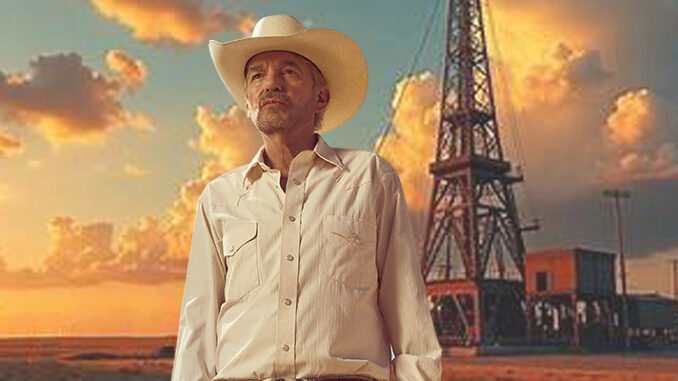
The second season just wrapped and viewers can’t get enough. Thornton plays Tommy Norris, a crisis manager for a West Texas oil company. “I’m a fixer and a foreman,” Thornton said in a pre–Season 1 interview. “There aren’t really a lot of scenes where my character comes home and says, ‘My God, was my day amazing!’ I slink into the house every day like somebody just beat the hell out of me.”
Sheridan wrote the role with Thornton in mind, and it shows. “Taylor really wrote this with my voice,” Thornton explained. “I pretty much played me as if I were a landman,” he told Cowboys & Indians. That approach, playing himself across wildly different roles, is something Thornton is unapologetic about.
“I play myself in everything,” he’s said to multiple outlets. “I don’t care how different it’s from me on the surface—the character in Sling Blade to the character in A Simple Plan to Bad Santa to this.” For him, separating yourself from the character weakens the work.
That truth extends to how he handles the show’s politics—or rather, how he refuses to frame it that way. When asked whether Landman carries an agenda, Thornton has been clear: “Taylor doesn’t write it with an agenda. This just gives you a look behind the curtain of the oil business.”
Outside of acting, Thornton has always maintained parallel lives. Music remains a constant, particularly with The Boxmasters, the band he’s been part of since 2006. They tour relentlessly and pull from ’60s rock influences that have little interest in modern genre boxes. As Thornton put it bluntly before a show, “Look, if you haven’t seen us before — we’re not a country band. We’re a rock ‘n’ roll band. And we’re loud.”
Thornton turned 70 last August, a milestone he once doubted he’d reach. “I didn’t think I’d make it to 30,” he told Cowboys & Indians. While he finds age irrelevant now, there was a moment it hit. “Actually, 70 didn’t freak me out; 60 didn’t freak me out. Fifty freaked me out because I got an AARP magazine in the mail.”
Thornton is candid about the contradictions. He’s eaten clean for years. He manages stress carefully. He believes deeply in happiness as a health strategy. And yes—he’s smoked cigarettes for most of his life and doesn’t plan on stopping. “My holistic doctor said, ‘Keep drinking the beer and smoking the cigarettes. Because you don’t have stress. If that makes you happy, do it because happiness will make you live longer,’” he said. It’s shocking advice by conventional standards—and very Thornton.

