
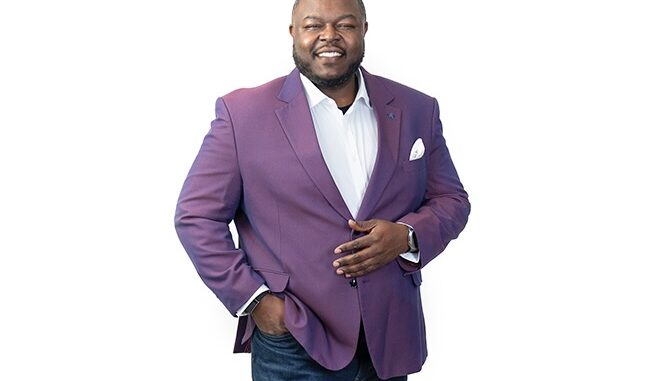
Kwame A. Ennin, MD, MBA, is redefining what orthopedic care looks like in North Texas — one patient, one joint, one life at a time.
By Sondra Barr
Photography by EM Corporate
Medicine was never really a choice for Kwame Ennin. It was simply the air he grew up breathing. His father is a physician. His mother, a nurse who followed in the footsteps of her own mother — a nurse midwife who practiced well into her 90s. His uncle is a physician. OBGYN and maternal health run so deep in the family that a young Kwame once overheard his father on the phone saying a patient was 10 centimeters dilated and instinctively announced, “He’ll be home in about an hour.” He was right.
“Medicine is kind of the family business,” Dr. Ennin says with a laugh. “There are other fields we dabble in, but there are a lot of doctors and a lot of nurses.”
He grew up in New York, earned his undergraduate degree in biochemistry from the State University of New York at Stony Brook, then headed to the University of Cincinnati College of Medicine before completing his residency at UT Southwestern/Parkland in Dallas. It was there, he says, that Texas got its hooks in him.
“I made really great personal and professional connections, and I decided to stick around,” he says. “It’s been one of the best decisions I’ve ever made.”
After a fellowship in adult reconstructive surgery at William Beaumont Hospital in Michigan, Dr. Ennin returned to North Texas and spent nearly nine years building a reputation at the Texas Center for Joint Replacement before joining Texas Joint Institute, where he has now practiced for over three years. A colleague and friend from his residency class is among the group’s founders — a connection years in the making.
“We always talked about the idea of working together and pooling our shared expertise,” he says. “It just worked out that we could do that within Texas Joint Institute.”
The Mechanics of Joy
Ask Dr. Ennin why orthopedics, and his answer is refreshingly simple: it was the specialty where he had the most fun.
“I really enjoy the mechanics of orthopedics,” he says. “I enjoy taking people who were debilitated with arthritis or had some type of traumatic injury and getting them back to being active and being able to enjoy their lives.”
Board-certified in orthopedic surgery with a fellowship in adult reconstructive surgery, Dr. Ennin specializes in total hip and knee replacements, partial knee replacements, revision surgeries, and osteoarthritis care — handling, as he puts it, everything from arthroscopy to the most complex revision total hips and knees. His patients range from people in their 20s to those well into their 80s and beyond, suffering from everything from the wear-and-tear of osteoarthritis to inflammatory and immune-related joint conditions.
He also incorporates robotic-assisted techniques — though he is careful to keep that in perspective.
“Robotics is a tool that is very exciting and developing, but it’s not the be-all, end-all of orthopedics,” he says. “To use the robot most effectively, you need to understand the parameters around which you’re doing the joint replacement — you have to evaluate whether the data going in is good and whether the data coming out is good, and then how that translates to your patient.”
He is experienced enough with robotics that he teaches the technique to other orthopedic surgeons for various implant companies — a point that speaks to the caliber of expertise he brings into his own operating room every day.
Concierge Care, Not Corporate Medicine
What sets Dr. Ennin apart isn’t just what happens in the operating room. It’s everything that surrounds it.
“My goal is to give patients a comprehensive, concierge-like experience,” he says. “Joint replacement is one of the most significant events in a person’s lifetime. My goal is to make it as painless as I can, as predictable as I can, and as communicative as I can — so that patients feel cared for, feel connected, have access, and know exactly what to expect at every step.”
That process begins long before surgery. When a new patient comes in, Dr. Ennin walks them through exactly what joint replacement is — and isn’t. He shows patient education videos. He has them watch testimonials from people at various stages of recovery, so they can hear it from someone who has been in their same shoes. His scheduler walks them through the facility, implant choices, and costs. Pre-operative clearances are coordinated. Before surgery, every medication and piece of equipment the patient will need afterward is already at home, waiting. And within the first seven days of recovery, a dedicated nurse on his staff calls every single patient to check in.
For the patient who has been putting off surgery for years — living with grinding pain, operating around it, quietly hoping it might improve — Dr. Ennin’s approach is not to push, but to educate.
“The decision about when to have surgery — or whether to have it at all — is always up to each individual patient,” he says. “But the most common refrain I get from patients is: ‘I wish I hadn’t waited.’ That’s what I tell them. And then it’s my job to come in and facilitate a great experience.”
A Walking Billboard
One story captures his philosophy perfectly. A woman in her 70s had moved to the area from out of town, carrying with her years of chronic hip pain she had tried to manage every way imaginable. After seeing Dr. Ennin, she was finally given a proper diagnosis: her hip had been the culprit all along. She was resistant to surgery — understandably so, after years of dealing with the condition — but she went through the education process, asked her questions, watched other patients’ stories, and ultimately decided to move forward.
The procedure was performed as an outpatient surgery. She was up and walking within a couple of hours. She went home the same day. Her recovery exceeded every expectation.
“She had moved into a retirement community,” Dr. Ennin recalls, “and she was such a walking billboard that many in the retirement community started calling and trying to come see me. She demonstrated that if you take the time to do your own investigation, if you hear your patient and communicate effectively, that experience can be so good that other people want it too.”
That reach extends well beyond North Texas. A mother and son flew in from Colorado specifically to have Dr. Ennin perform their surgeries, then recovered at home with follow-up managed through video conferences and coordination with their local physical therapists.
“We want to be where the patients are,” he says of Texas Joint Institute’s multiple locations spanning Allen, Dallas, Frisco, Lakewood, McKinney, Plano, Sachse, and Sherman. “We want access to be easy. But we are also a regional powerhouse — and that means patients come to us from all over the state, and frankly, all over the country.”
The Doctor With a Business Degree
Dr. Ennin holds both an MD and an MBA — a combination that turns heads, even in a field that increasingly values the intersection of medicine and management. When asked how the business side of his brain makes him a better doctor, his answer cuts right to it.
“One of the jobs I didn’t know I was signing up for was managing my patients’ healthcare dollar,” he says. “Your health insurance is trying to gauge who has good outcomes and who is delivering those good outcomes in a cost-effective manner. So, you have to continually evaluate the best evidence — the best data on implants, medications, surgical techniques — and deliver that in a cost-effective way. My goal is to make sure my patients have as good an outcome as anybody, but I don’t want them to pay a premium for no good reason.”
At the Track and Beyond
Off the clock, Dr. Ennin is a fixture on the track and field circuit. His eldest daughter — a national champion in her events — is currently a freshman at Stanford, with her eyes on dermatology and plastic surgery. His two younger children are equally dedicated athletes.
“We are a very big track family,” he says. “Whatever they need — if they need me to set up tents, I’m setting up tents. If they need me to make hamburgers, I’m making hamburgers. And if they need me to look at somebody’s knee — I’m looking at somebody’s knee.”
He is equally intentional about mentorship in the medical community, regularly hosting high school students, college students, and medical students who shadow him or collaborate on research projects — a way of paying forward the investment others made in him.
The Long Game
Twenty years from now, when the patients Dr. Ennin has operated on are hiking trails, dancing at weddings, chasing grandchildren, or simply walking to the mailbox without wincing — what does he hope they remember about him?
“I hope they remember the smiles and the jokes,” he says. “And the transition. The before and the after. How much their life improved. And I hope it motivates them to spread the word — so that other patients can find that there’s a doctor out there who genuinely cares.”
That, in a nutshell, is what Dr. Kwame Ennin is building — a practice where expertise and empathy aren’t mutually exclusive, where the patient in front of him is the only thing that matters in that moment, and where getting people back to their lives is not just the job description, but the whole point.
Kwame A. Ennin, MD, MBA, is a fellowship-trained, board-certified orthopedic surgeon at Texas Joint Institute, with locations in McKinney and Plano. For appointments, visit txjointinstitute.com or call (972) 566-5255.