
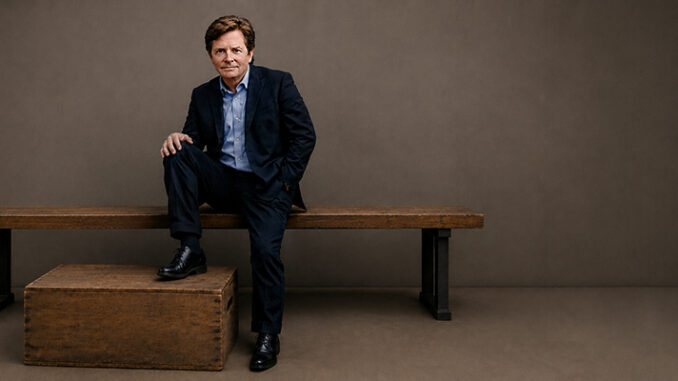
By Sondra Barr
There is a version of Michael J. Fox’s story that reads as one long run of hard luck, and he is the first to tell you he doesn’t live in it. He built one of the most beloved careers of his generation as Alex P. Keaton on Family Ties, Marty McFly in 1985’s Back to the Future and Deputy Mayor Mike Flaherty on Spin City. He has also carried Parkinson’s disease for more than three decades, since a diagnosis that arrived at the very peak of his fame. He recently turned 65. Actor, author, advocate, and, by his own cheerful insistence, a lucky man.
The middle initial, it turns out, is a bit of invention. He was born Michael Andrew Fox, but the Screen Actors Guild already had a Michael Fox on its books when the teenage Canadian arrived in Los Angeles. Rather than become “Michael A. Fox,” he borrowed a “J” in tribute to character actor Michael J. Pollard, a small act of reinvention from a kid who would make a career of them.
The climb was anything but smooth. Before Family Ties made him a star, Fox was broke enough to sell his furniture piece by piece. “I owed the IRS a lot of money. I was just out of prospects and it was really rough,” he told Route Magazine. The sitcom made him the youngest actor ever to win a lead-comedy Emmy; Back to the Future made him famous worldwide. At 23, he recalled, he had “a Ferrari, a Mercedes, and a Range Rover” and a daily decision to match: “What car am I gonna drive to Paramount today?”
Then, in 1991, while filming Doc Hollywood, the pinky on his left hand began to twitch and wouldn’t quit. The diagnosis was early-onset Parkinson’s disease. He was 29.
“I had no idea what that meant, because Parkinson’s to me was a thing that … it was just an old person’s disease. It was a concept more than it was a disease,” he told Route Magazine. The fear came from what he saw on other people’s faces. “I was scared. I was more confused than scared, but I was scared,” he said. “I had a sense of free-floating doom, but I had nothing to affix it to.”
He told almost no one. For seven years he kept working and kept the secret, hiding a worsening tremor from cameras and crews. By 1998 the symptoms had outpaced his ability to hide them, and he chose to tell his own story before the tabloids told a sensationalized one.
Across three decades of interviews, he rarely reaches for self-pity. “The end is not pretty — I’d like to stop it from its logical conclusion — but I’m grateful,” he told People. “It’s made me stronger. A million times wiser. And more compassionate.” Having Parkinson’s, he said in 2008, “is part of an amazing life. And not an ‘otherwise’ amazing life.”
He is also careful not to speak for anyone else’s hardship. “I understand Parkinson’s is a real hardship for [some] people, and I’m not trying to be insensitive to them,” he told People. “Yes, it’s a horrible condition. Would I choose not to have it? Yeah, I think so. But it’s not my choice.”
Beneath the optimism runs one steadying constant: Tracy Pollan. The two met playing love interests on Family Ties in 1985, reconnected two years later filming Bright Lights, Big City and married in 1988. Pollan’s first impression was not the stuff of fairy tales. “He was very cocky … He was funny, but he was cocky,” she recalled to People.
The marriage has absorbed a great deal: the diagnosis, a period of heavy drinking Fox chronicled in his memoir Lucky Man, and the quiet renegotiations chronic illness forces on a couple. He has written about waking on the couch to find Pollan standing over him with their young son. “As I lay there on the couch that morning, I knew that alcohol had become yet another adversary,” he wrote. “Which meant the alcohol had to go.”
Learning to be cared for took longer than learning to cope. “It took me a while to get that it wasn’t just about me,” he admitted to People. “If I break my arm, I’m dealing with my broken arm. But if you’re the person who lives with and loves and supports the person with the broken arm, you’ve got to do everything.”
His own theory of the marriage is refreshingly unromantic. “We just really like each other, and we trust each other,” he told Route Magazine. “Like Tracy always says, we give each other the benefit of the doubt. … The person I live with every day of my life, why would I want to hurt them?” Pollan’s summary, offered near their 30th anniversary, is tidier still: “It was us against the world. That’s exactly what we’ve created.”
Together they raised four children, son Sam and twin daughters Aquinnah and Schuyler, followed by daughter Esmé. Of fatherhood, Fox says, “It’s been the best part of my life.” Raising daughters, he told Route Magazine, is “just pure love. … They’re so mysterious.”
In 2000, Fox converted his fame into something durable, founding The Michael J. Fox Foundation for Parkinson’s Research and seeding it with proceeds from Lucky Man. It has since grown into the world’s largest nonprofit funder of Parkinson’s research, driving more than $2.5 billion into the field. “I’m not a scientist. I’m not a businessperson. But I am someone living with Parkinson’s,” he told U.S. News & World Report. “We’re all involuntary experts on the disease.”
His goal for the foundation is, fittingly, its own obsolescence. “We’re in business to go out of business,” he has said. “Truly what I’m most proud of, is the people who have Parkinson’s. … If I made it easier for people to explain what they’re dealing with, to say well, it’s the thing Michael J. Fox has — then that’s a great gift.”
He discusses mortality without flinching; he has said he doesn’t expect to reach 80. The humor stays intact. When CNN mistakenly published a “Remembering the life of actor Michael J. Fox” tribute video this year, the very-much-alive Fox answered on Threads with a multiple-choice quiz of appropriate reactions, among them: “(B) Pour scalding hot water on your lap, if it hurts you’re fine.” He signed off, “I thought the world was ending, but apparently it’s just me and I’m OK. Love, Mike.” Kathy Griffin’s reply: “You’re a helluva ghost.”
The recognition has been considerable over the years, five Emmy Awards, an honorary Oscar and, in January 2025, the Presidential Medal of Freedom. He announced his retirement from acting in 2020, then stepped back for a 2026 guest turn on Shrinking opposite Harrison Ford, whose character also has Parkinson’s. The work, like the man, isn’t finished. “As a parent, husband and friend, I have a lot left to do,” he told People.
Ask whether he’d surrender the disease that reshaped his life, and the answer comes instantly, then pivots, as it always does, toward the good. “Parkinson’s? I’d give it up in a second,” he told Route Magazine. “To be put in a position where I can help affect that change, it’s the most humbling thing and the thing that I am most proud of.”
It is, in the end, the same move he has made for 30 years: finding the good and seizing it. As he put it, simply, to People: “You take the good, and you seize it.”

