
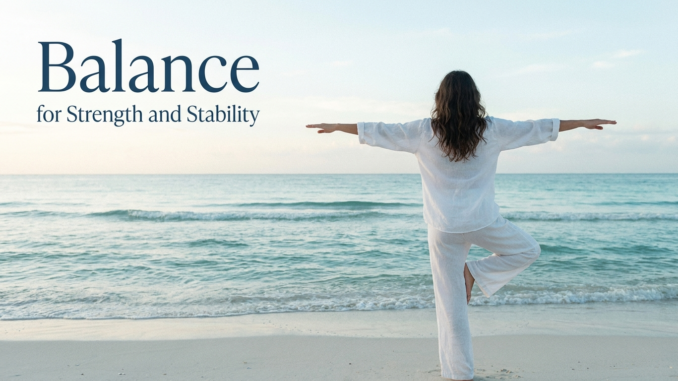
By Madison Finch
Like strength or flexibility, it can improve with attention and practice. As you work on your balance, the benefits will extend far beyond simply staying upright.
Having good balance matters more than you think. It’s one of those things most of us rarely think about, until we suddenly feel unsteady. Maybe it happens while stepping off a curb, reaching for something on a high shelf, or standing on one foot while putting on a shoe. In these small moments, balance reveals itself as something quietly essential. It’s not just about avoiding a fall; it’s about maintaining confidence and remaining capable in the way we move through everyday life.
Balance is a remarkable dance between your body’s systems. It depends on a complex partnership between your muscles, your eyes, your inner ear, and your brain. When all of those systems communicate smoothly, your body instinctively knows how to adjust when the ground shifts beneath you or when you change direction. When one of those systems weakens or becomes less responsive, stability can start to feel less certain.
The good news is that balance is not a fixed ability. Like strength or flexibility, it can improve with attention and practice. As you work on your balance, the benefits will extend far beyond simply staying upright. Researchers at the Harvard T.H. Chan School of Public Health have noted that balance training strengthens the body’s stabilizing muscles, particularly in the core, hips, and legs—while also improving coordination and reaction time. In practical terms, that means smoother movement, quicker adjustments when something unexpected happens, and greater confidence in daily activities.
Balance also plays an important role in preventing injuries. According to the Centers for Disease Control and Prevention, falls remain one of the leading causes of injury among adults in the United States. But what’s encouraging is that studies show regular balance exercises can significantly reduce the risk. The CDC’s fall prevention research has consistently shown that activities that improve strength and balance such as Tai Chi, yoga, and targeted stability exercises can make a measurable difference.
But beyond statistics and research findings, balance has a deeper connection to how we experience our bodies. When balance improves, movement feels smoother. Walking feels lighter. Climbing stairs feels easier. Even standing for longer periods becomes more comfortable. These changes may seem small, but they add up to a greater sense of independence and ease in everyday life.
When balance is neglected, those systems can become less responsive. Muscles that support the joints may weaken, reaction time may slow slightly, and the brain may receive less precise signals about where the body is positioned in space. Over time, this can create a sense of hesitation or uncertainty during movement.
Incorporating balance into daily routines doesn’t require an hour-long workout. It might mean standing on one foot while folding laundry, taking a short walk outdoors, or adding a few simple strengthening exercises to your morning routine. Over time, those small moments of practice reinforce the systems that keep you steady.
Fortunately, improving balance doesn’t require complicated routines or specialized equipment. Often, the most effective exercises are surprisingly simple. One of the easiest starting points is practicing single-leg balance. Standing on one foot while brushing your teeth or waiting for the kettle to boil can gently activate the muscles that stabilize your hips and core. Over time, your body learns to make those subtle adjustments more efficiently.
Another helpful practice is mindful walking. Instead of rushing from place to place, pay attention to how your feet meet the ground. Notice your posture, your stride, and the way your arms swing naturally. This kind of awareness strengthens the brain-body connection that supports coordination and stability.
Activities that challenge balance in a controlled way can also be particularly beneficial. Yoga, for example, includes poses that strengthen the legs while encouraging steady breathing and concentration. Tai Chi, a slow and graceful form of movement often described as “meditation in motion,” has been widely studied for its balance benefits.
Strength training also plays a critical role. While balance exercises help the body respond quickly to instability, strong muscles provide the foundation that keeps joints supported. Strengthening the legs through exercises such as squats, step-ups, or gentle resistance training can significantly improve balance and reduce fall risk.
Posture is another factor that often goes overlooked. Many of us spend long hours sitting, which can gradually weaken the muscles that help keep the spine aligned. When posture becomes rounded or forward-leaning, the body’s center of gravity shifts, making balance more difficult. Standing tall with the shoulders relaxed and the head aligned over the spine helps restore the natural alignment that supports stability.
Vision also contributes more to your balance than many people realize. Your eyes constantly provide information about your surroundings and help your brain orient the body in space. As your vision changes over time, your balance may feel slightly different as well. Regular eye exams and proper lighting in the home can quietly support safer movement.
The inner ear plays its part, too. Tiny structures within the ear detect motion and changes in head position, sending signals to the brain that help regulate balance. When this system is disrupted, whether by illness, inflammation, or certain medications, people may experience dizziness or vertigo.
Perhaps the most encouraging truth about balance is that improvement can happen at any stage of life. The body remains adaptable, and even small, consistent efforts can produce meaningful change.
Think of balance as a conversation within your body—a constant exchange of information between muscles, joints, senses, and brain. The more that conversation is practiced and strengthened, the more naturally stability becomes part of everyday life.
As the seasons change and routines shift, it can be a good time to check in with your own sense of stability. Are you moving with ease? Do you feel confident stepping onto uneven ground or reaching for something overhead? If not, a few minutes of balance-focused movement each day can gradually restore that sense of steadiness.
Strength and stability are not separate goals. They work together, supporting the body in ways that often go unnoticed until they are challenged. By caring for balance now, through movement, awareness, and simple daily habits, you create a foundation that supports both safety and vitality for years to come.